SPDI

Sustainable Product Design & Innovation is a degree program developed early in the 21st century at Keene State College. Keene State College is part of the University System of New Hampshire. Here is a link to the schools website https://www.keene.edu/academics/programs/spdi/

It took me a couple years to figure out the acronym SPDI. At first I had assumed it was a STEM or STEAM program (I can be oblivious). Then I noticed that the letters didn’t match. I had to ask what they ment.

My first introduction to SPDI was a tour with the Society of Manufacturing Engineers were we saw their first 3D printers and a machine shop. A few years later we were invited student presentation on their Manufacturing Enterprise course to the . I was quite impressed. I had spent most of my life in manufacturing and the students did a good job of representing the manufacturing structure.

A few years later I was asked to join academia and become a member of SPDI staff. It has been a privilege. Somewhat surprisingly this has been my third longest job. I have only spent more time making automobile headlights and medical devices. Having worked with many engineers in the past, I hope to train the students how to be better engineers.

Let me break down what SPDI means to me.

Let’s start with the word sustainable. The UN defined sustainability in 1987 as the ability to meet the needs of the present without compromising the ability of future generations to meet their own needs. Written by international politicians that statment can mean whatever you want it to be. I am sure someplace that would be, I have slaves, so my children should have slaves. Myself, I would say, make good things so you do not go out of business. Yes, sustainable is considered a political word. Politicians do choose what is sustainable, that is the way things work. Most politicians support manufacturing. They know we need things.

The next word is product. This is a word I can understand. A product is a thing. Our world is made of things. We depend on things. There is no society without things. Things keep us alive and let us live longer. The vast majority of things in our lives are manufactured. Musical instruments, books, paint brushes, and your phone are all manufactured. Manufacturing is an art.

Design, how do we define our things. How big are they, what are things made of? How are going make these things. We learn computer aided design, how to digitally render things. That is just the start. When we have a thing, how does it relate to other things. How do things work together. Are there unexpected consequences? Form fit and function is what we said in the factory. How does the product do the job? I could go on and on, however I will take a break and go on to what may be the most important word.

Innovation, for me it means collaboration to make better things. How can we make better things? Can we improve the result of two interacting things? Can an assembly of things work better together? That is what learning is.

SPDI is something I can belive in. Recently I have been trying to promote SPDI by giving away SPDI jackets that the students designed. As usual, some people do not agree. We are a Liberal Arts school, not a technical college. My view is manufacturing is the one art all the other arts are dependent on. Just my opinion.

What Are You Thinking?

This old asymmetric face almost never gets asked that question. It seems nobody really is cares what I think. I have written hundreds of little stories here and have only received a handful of comments. Still, I like to write. I write for me. Most of the time I write about something because someone else has mentioned something. Typically they cannot see an alternative point of view. So if they actually cared about listening they could find something here.

The last time I remember being asked about what am I thinking was a few years ago. I think it may have been about personal relationships. I was too shocked to answer. I did appreciate the question because relationships are precious. Today though, I was asked in a questionnaire about my goals in school. That is really the same thing as asking what I am thinking. So let me tell you.

Some times when a student asks a specific question I may say “The truth is not allowed” for frequently the truth is not a part of the narrative. Some of the time these questions may be political or politically related, and I will not take a political stand in school. I try not to disagree with the curriculum, but I have strong feelings about what is taught. I will summerize and expand on what I wrote in the form today.

Manufacturing is an art. It may be the most important art of them all. Without manufacturing we wouldn’t have the other arts as we know them. Sure we could sing, but we couldn’t record the music. We could bang on a log, but we certainly couldn’t amplify the sound. We could paint, but we couldn’t hang it in the Louvre. All the good things in life wouldn’t be here. I do enjoy the arts.

So why are we in the 17th century? Sure the art of spindle turning was invented in the 17th century. One of the handcrafted chairs in the above image has turned spindles. Most of the other chairs have hand drawn spindles. The bench in the foreground is what is used to shape the spindles and other parts with the draw knife shown. The wood is split by hand with wedges on the log that is in front of the chairs. These individually hand crafted wood chairs are made in the wood shop. The priority here is given to the feel of the cutting tool.

Whoever designed the wood shop gave it an epoxy floor. It is easy to clean. My shop is the metal shop, whoever designed my shop gave it a concrete floor. People in my shop spill oil. People in the wood shop spill wood chips. If oil were to spill on a epoxy floor it would be easy to clean. If wood chips were to spill on a wood floor it would be easy to clean. But no! They gave me people that spill oil on a concrete floor. That is impossible to clean. Life is unfair.

We should be teaching people the art of digital fabrication. That is a saleable skill. How many people want to hire someone who knows how to make a 17th century chair. Yet the decision making priorities have been given to the person making 17th century chairs. Like the 17th century we have empowered a completely feudal mindset.

This is not how to build the future in the 21st century. The key is digital fabrication. Learning the language of the machines. Machines will speak to you if you know how to listen. Listening and communication, that is how to learn. We need to know how machines think and work. How to manipulate software to create things. We need to teach machines how to see with vision systems. How to program robots to do things we cannot. We need to remember everything is alive. We need to know how to make the recipes that make things better.

When people are stressed they tend to stick with the things they know. If they have old ideas, that is what they stick with. They believe in what has worked for them in the past. This is true especially if they think they are the smartest people in the room. Myself, I have had to reinvent myself a number of times. I know that I am not the smartest person in the room. Because of that I listen, and identify who knows what they are talking about. Then I help them. It also works the other way around. The smart students listen to everyone in the room. They then evaluate the relative intelligence of the people, and listen to the smart ones. Those that stand in feudalistic judgment are unhappy.

My objective is simple. Have a student define a thing digitally, then produce the thing digitally. Then define digitally how that thing relates to other things. Finally, collaborate with others how to make better things.

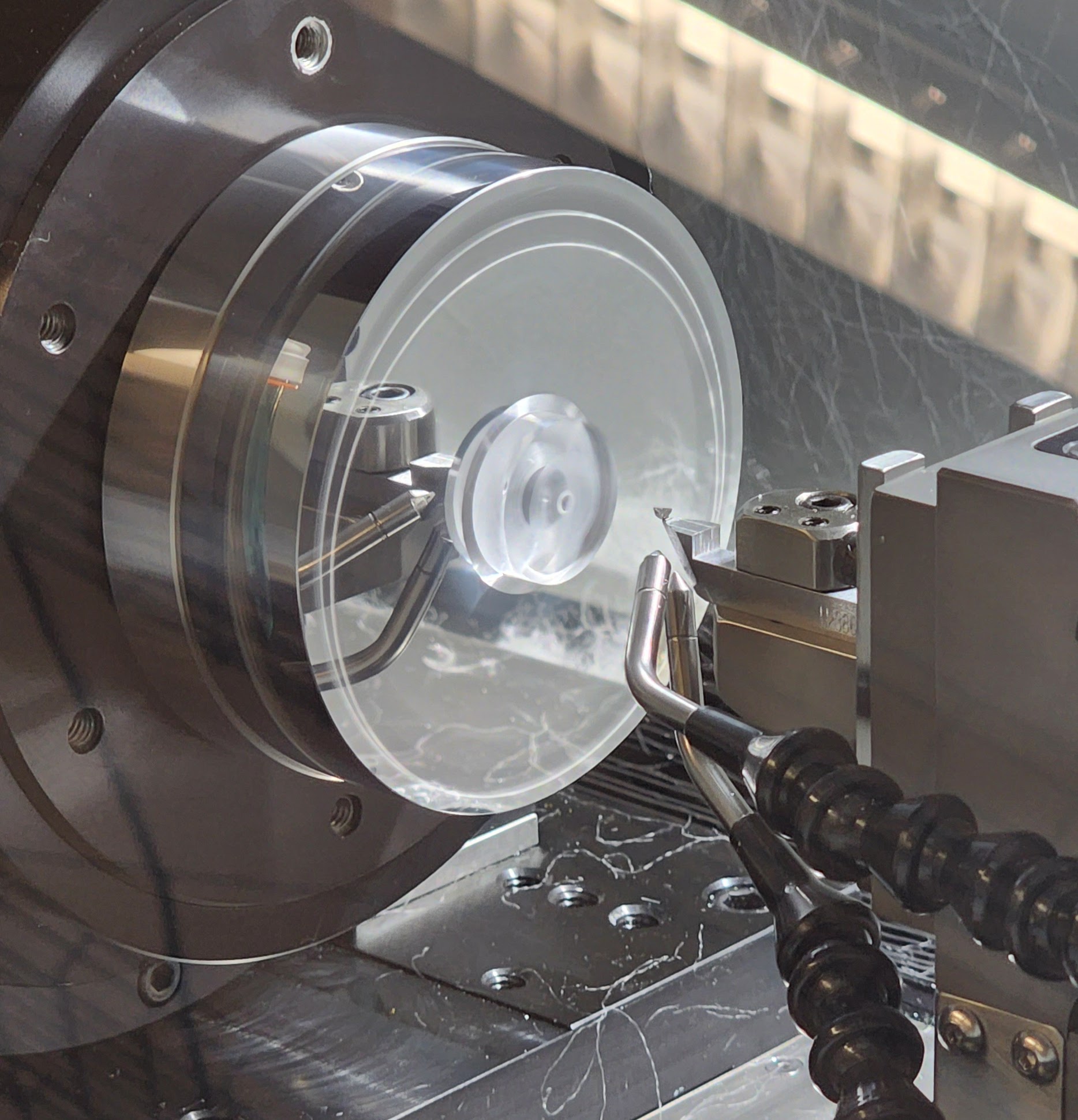
Things may not be as bad as I say. We have some new diamond lathes. They are incredibly accurate. We also received some machines that can measure form and finish down to the nanometer. They are machines for the 21st century. They are properly modern.

Here is a view of one of the new machines working. The little diamond on the tool is making a perfect optic. You can see it just to the right of the small disk that will become an optic. Lots of opportunity to learn. The students running these things are doing a wonderful job. My job is to drag those stuck in the 17th century into the 21st century. Not an easy job. Sometimes I think that it would be easier to get cats in a row. That is the challenge.